
New York, United States — May 12, 2026
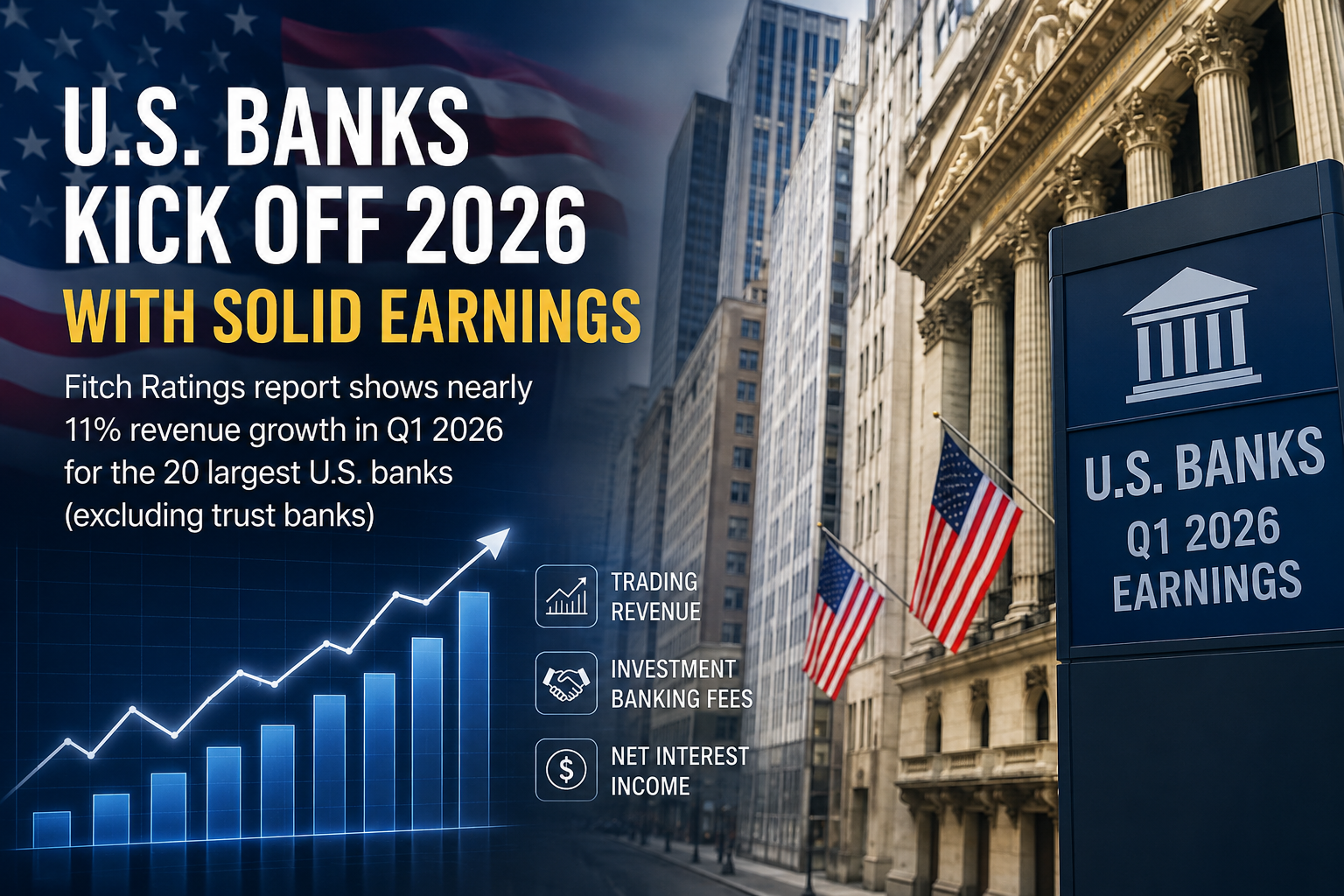
Large U.S. banks started 2026 on firmer footing, supported by strong trading activity, improving investment banking fees, and resilient net interest income, according to a recent report from Fitch Ratings.
The report found that median revenue for the 20 largest U.S. banks excluding trust banks rose nearly 11% year-over-year in the first quarter. Most lenders also maintained positive operating leverage, keeping expense growth below revenue growth despite continued pressure on operating costs.
Trading desks and capital markets divisions were among the biggest contributors to earnings growth during the quarter. Banks including JPMorgan Chase and Citigroup benefited from stronger client activity and improved market conditions, particularly across investment banking and trading operations.
Fitch noted that profitability across the sector remained broadly stable, with stronger fee income helping offset slower growth in lending-related revenue.
Margin Pressure Begins to Surface
The quarter, however, was not uniformly strong across the industry.
Wells Fargo and several regional banks reported softer net interest income and weaker lending momentum as expectations around future interest rate cuts continued to weigh on margins. Some lenders also missed analyst expectations, putting pressure on share prices.
Even so, broader concerns around the sector remain limited for now. Credit quality stayed stable across most major banks, whilst capital levels remained comfortably above regulatory requirements despite slight declines in CET1 ratios at some institutions.
Several banks also maintained or slightly improved their full-year guidance despite ongoing geopolitical and economic uncertainty.
One notable shift is that market-driven income is again carrying a larger share of earnings growth after two years where higher interest rates did much of the heavy lifting for the industry.
US banks: What It Means
Why It Matters for Emerging Markets
The performance of large U.S. banks often shapes broader investor sentiment across global markets, particularly in emerging economies such as India.
Stronger earnings and stable balance sheets at major American lenders generally support foreign capital flows into emerging market equities and debt markets. That can help liquidity conditions across South Asia, especially at a time when investors remain selective around global risk exposure.
However, if interest rate cuts accelerate later this year, pressure on bank margins could intensify globally. Slower profitability in the U.S. banking sector may eventually lead to more cautious capital allocation and increased volatility across emerging market currencies, including the Indian rupee.
India’s domestic growth outlook nevertheless remains relatively strong compared to several developed markets, supported by infrastructure spending, private investment, and steady domestic demand.
The Bigger Picture
The first quarter reinforced the resilience of large U.S. banks, but sustaining that momentum may become more difficult in the second half of the year.
With interest rate tailwinds beginning to fade, banks are expected to rely more heavily on fee income, operational discipline, and balance sheet management to maintain profitability in a slower and less predictable environment.
DTO Analysis
Stable earnings from major U.S. banks matter beyond Wall Street because they directly influence global liquidity, investor risk appetite, and cross-border capital flows. For emerging markets, particularly India, a stable U.S. banking system supports trade financing conditions and broader investment activity.
At the same time, pressure on margins and slowing lending growth in developed markets could eventually tighten global capital allocation, making funding conditions more selective across trade, fintech, and corporate banking sectors.
Related on Digital Trade Outlook
- HDBank partners with London Stock Exchange to open global capital access for Vietnamese firms
- Afreximbank and EABC Sign Africa Trade Gateway Agreement to Open Digital Trade to East African Businesses
- Standard Chartered to Launch Institutional Bitcoin and Ether Spot Trading in the UAE