

ASEAN ministers signed the Digital Economy Framework Agreement (DEFA) in Manila on 14 November 2026, ending negotiations that began in September 2023. It is the bloc’s first standalone, legally binding digital economy agreement, with common rules on digital trade, cross border data flows, electronic payments, cybersecurity and artificial intelligence. Singapore’s Ministry of Energy, Trade and Industry says it will enter into force 180 days after signing, which points to mid May 2027, and will replace the 2019 ASEAN Electronic Commerce Agreement. ASEAN aims to double the value of its digital economy to $2 trillion by 2030.
On the same day, Asian Development Bank President Masato Kanda pledged up to $5 billion by 2030 to support DEFA’s implementation, covering digital infrastructure, cross border data and payments, cybersecurity, AI readiness and digital inclusion. He also announced the ASEAN Resilient Rivers Initiative, which aims to mobilise up to $8 billion by 2030 for water and food security. Kanda said the two initiatives complete ADB’s pledge, made in May, of up to $30 billion for ASEAN priorities by 2030.
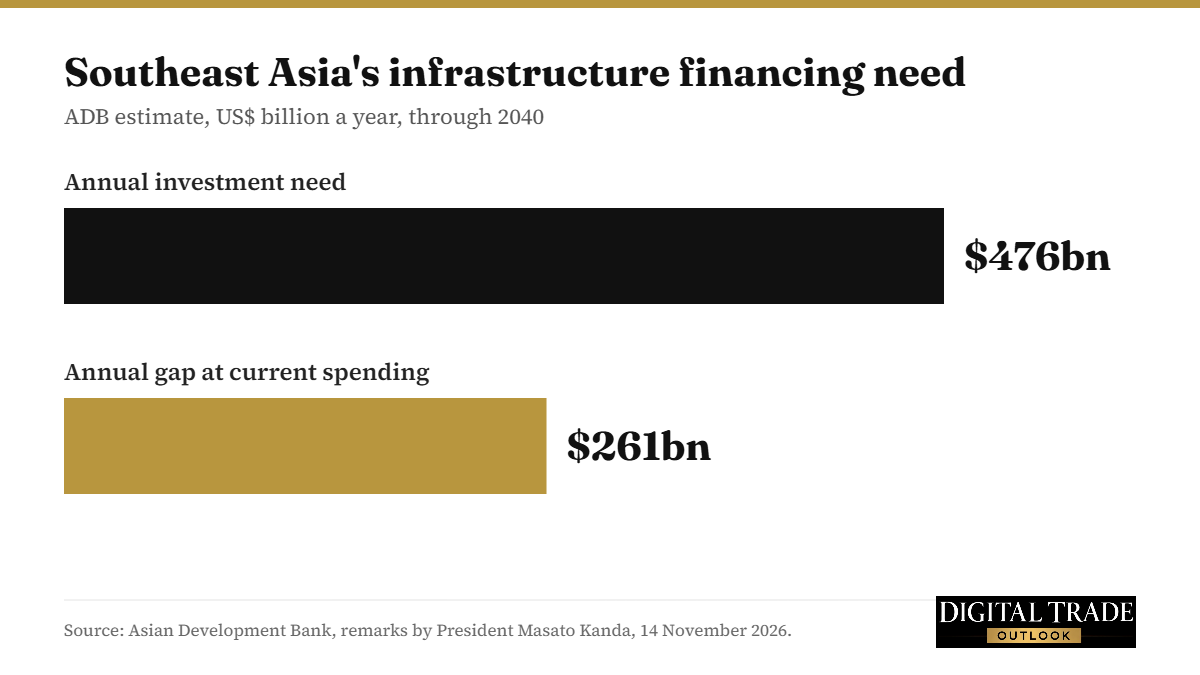
Kanda’s main message at the ASEAN Business and Investment Summit was about projects, not money. ADB now estimates Southeast Asia needs about $7.1 trillion of infrastructure investment through 2040, roughly $476 billion a year or 8.7% of GDP, more than twice its previous estimate. At current spending, governments cover less than half, leaving an annual gap of about $261 billion. “Capital is not the binding constraint. Investable projects are,” Kanda said, calling for predictable regulation, transparent procurement and stronger project preparation.
In October, Digital Trade Outlook examined what the agreement means for payments, data and trade documents in ASEAN’s DEFA Moves Digital Trade Rulemaking Beyond the WTO.
Willing countries go first
The agreement lets willing countries move ahead first while others join later. Singapore’s Deputy Prime Minister Gan Kim Yong said he hoped “we will already be ready with a few initiatives” by the time it takes effect. He named digital payment systems, digital identities for businesses and electronic trade documentation as possible early projects. Officials are drafting implementation plans. At the ASEAN Economic Community Council meeting in Manila on 14 November, Indonesia’s Coordinating Minister for Economic Affairs Airlangga Hartarto said Indonesia “supports expediting the ASEAN DEFA Implementation Plan by considering the domestic readiness of each country.”
None of the announcements made at the signing named which projects will come first, which countries will take part or when the first services will run.
The three projects Gan named are the ones that matter most to trade finance. A business digital identity tells a bank who it is dealing with across a border. Electronic trade documents are what a bank examines before it pays. Payment links decide how quickly money settles between markets. If the first services start in a handful of countries, banks serving regional clients will run digital corridors in some markets and paper in others for some time.
Money waits on projects
Kanda’s point applies directly here. ADB’s $5 billion can finance a payment link or an identity scheme only after the participating countries agree its design, who operates it and whose rules apply. The money is available up to 2030. The bottleneck is the work needed to turn a regional text into a system that a bank in one ASEAN market can rely on when dealing with another. The implementation plan, and the list of countries willing to sign up to the first projects before the agreement takes effect in May, will show how much of DEFA reaches traders in 2027 and how much stays on paper.
Related on Digital Trade Outlook
- When Development Banks Carry the Risk, Who Is Really Lending?
- Shipping Goes Digital, but Banks Remain a Hurdle to Paperless Trade
- If Data Rules Stop at Every Border, Can Trade Finance Keep Moving?
Image: ASEAN and Asian Development Bank logos