

Canada’s Real-Time Rail (RTR) went live on 9 November 2026 with eight participants: Wealthsimple, Questbank, Peoples Trust Company, Paramount Commerce, KOHO, DoBusiness.com, Digital Commerce Bank and Bank of America. None of Canada’s major banks was on the launch list. Payments Canada, which owns and operates the system under Bank of Canada oversight, says all major Canadian financial institutions are onboarding in the coming months and that the rail will be available to more than nine in ten Canadians within its first year.
Ten days before the launch, on 30 October, Canada and the European Union announced the Canada-EU Alliance for the Future at their summit in Montréal. Among its commitments, the two sides said they would support work by the Eurosystem, the Bank of Canada and Payments Canada to connect the RTR with the EU’s TARGET Instant Payment Settlement system, known as TIPS. No date has been set.
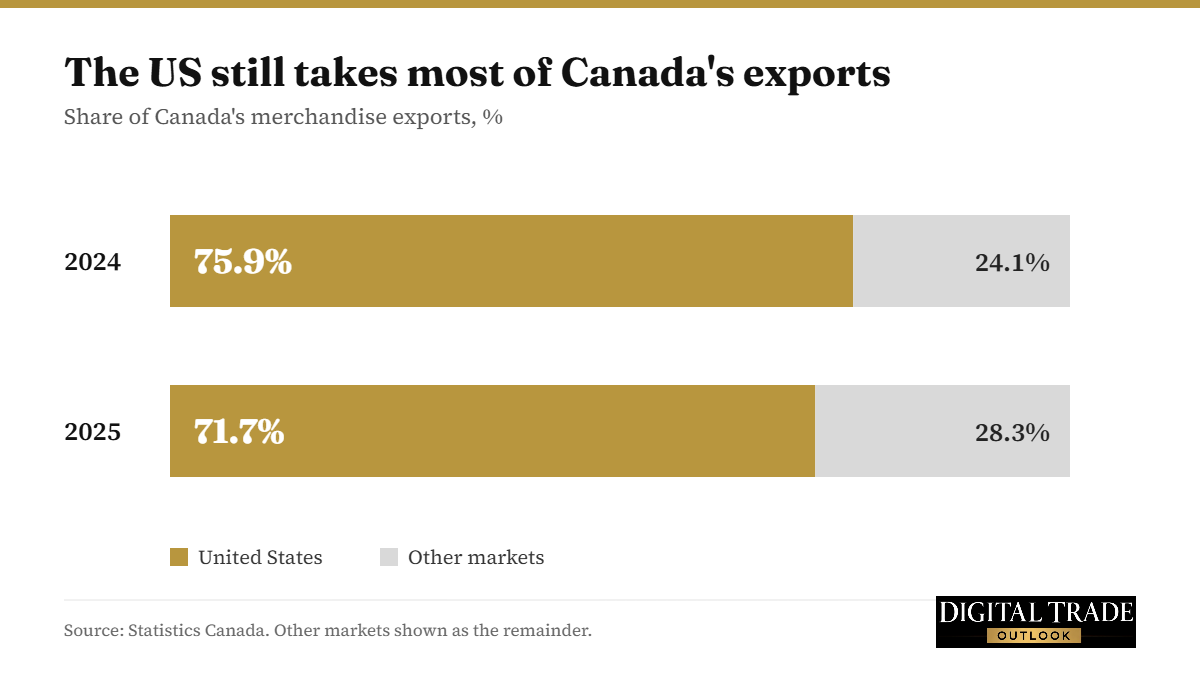
That link runs to Europe. Canada’s largest market lies to the south. The United States took 71.7% of Canada’s merchandise exports in 2025, down from 75.9% in 2024, according to Statistics Canada.
The RTR clears and settles payments in real time, around the clock, using ISO 20022, which Payments Canada describes as data rich messaging. Payments Canada says Canada is the first G7 country to launch a real time payment system with mandatory centralised fraud services from day one. These include confirmation of payee, a fraud “safety” score on each transaction, a risk list of accounts tied to confirmed fraud, and a fraud reporting and intelligence platform. Confirmation of payee covers consumer accounts at launch. The launch announcement does not say when business accounts will follow.
Access for most companies will depend on when their own bank joins. Payments Canada’s timeline brings in the first Interac e-Transfer migration participants in the first quarter of 2027, more in the second, and all participants in the initial launch phases at full transaction volumes by the third quarter.
Demand is there. In a Payments Canada survey of 507 businesses, carried out between 23 March and 3 April 2026 and published in August, 60% said they were ready to adopt real time payments to deal with everyday payment bottlenecks. A C.D. Howe Institute memo published on 2 September estimated savings of C$5.3 billion to C$14.5 billion over the rail’s first ten years. The savings would come from cheaper processing as cheques and cash decline, and from shorter delays before funds reach recipients. These are projections, and the upper figure assumes strong adoption.
Europe first, the US later
Payments Canada says the RTR was built to international standards, which makes it extensible beyond Canada, and points to ISO 20022 as essential for linking with systems in other markets. A shared message format does not settle a payment across borders on its own, though. Any link with TIPS would still need agreed rules on access, currency conversion and settlement between the two systems.
The US is working on its own plumbing for payments across borders. On 8 April the Federal Reserve Board proposed letting US banks and credit unions use intermediaries to transfer funds through FedNow. That would allow a US bank to use FedNow alongside correspondent banks for the international portion of a payment. Today a FedNow transfer can involve only two US banks. On 23 September the Fed announced a pilot of enhanced message formats for the US domestic leg of international payments, with the overseas leg still running through correspondent banks or other intermediaries. Neither announcement mentions Canada or the RTR.
For a Canadian exporter paid by a US buyer, the new rail covers only the Canadian end. The money still crosses the border through correspondent banking, with the foreign exchange conversion and compliance checks that come with it. Bank of America is on the RTR from launch, but nothing announced so far connects the rail to a US instant payment network.
What decides the rail’s reach
The early gains for Canadian companies will come from domestic receipts: faster availability of funds, cleaner reconciliation and fewer cheques. Two things will decide how far that reaches into trade. The first is how quickly the major banks join and offer business services, including confirmation of payee for corporate accounts. The second is whether the Europe link moves from a summit commitment to a project with a timetable.
None of the announcements from Payments Canada or the Federal Reserve so far sets out a link between the RTR and a US instant payment system, the corridor that carries most of Canada’s exports. Until that changes, the rail will matter more to Canadian treasurers managing domestic cash than to exporters waiting on payment from the United States.
Related on Digital Trade Outlook
- Two Months Out, Can Banks Outside the Euro Area Convert and Credit an Instant Euro Payment in 10 Seconds?
- Payee Checks Are Spreading. Company Bulk Payments Can Still Opt Out
- Swift and Iberpay Link Spain’s Instant Payment Rails to Cross-Border Transfers
Image: Payments Canada logo