
From November 2027, every financial institution on Swift must send payment cancellation requests and responses through its Stop and Recall service, using ISO 20022 messages over FINplus. The MT n92 and n96 cancellation messages will be removed, free format MT n99 will be retired for cancellations, and the in-flow translation that lets MT and ISO 20022 users exchange recalls will end. Swift has already postponed this mandate once, so banks can keep exchanging cancellations bilaterally in either format until November 2027.
Banks get access to the service with no setup: Swift will give it automatically to every eligible institution. The service routes each request to the right bank, chases it with automatic reminders and tracks it under one investigation reference. That still leaves each bank to find the original payment, check whether it has settled and answer the request. The mandate gives a bank the connection. Its own back office still has to do the work.
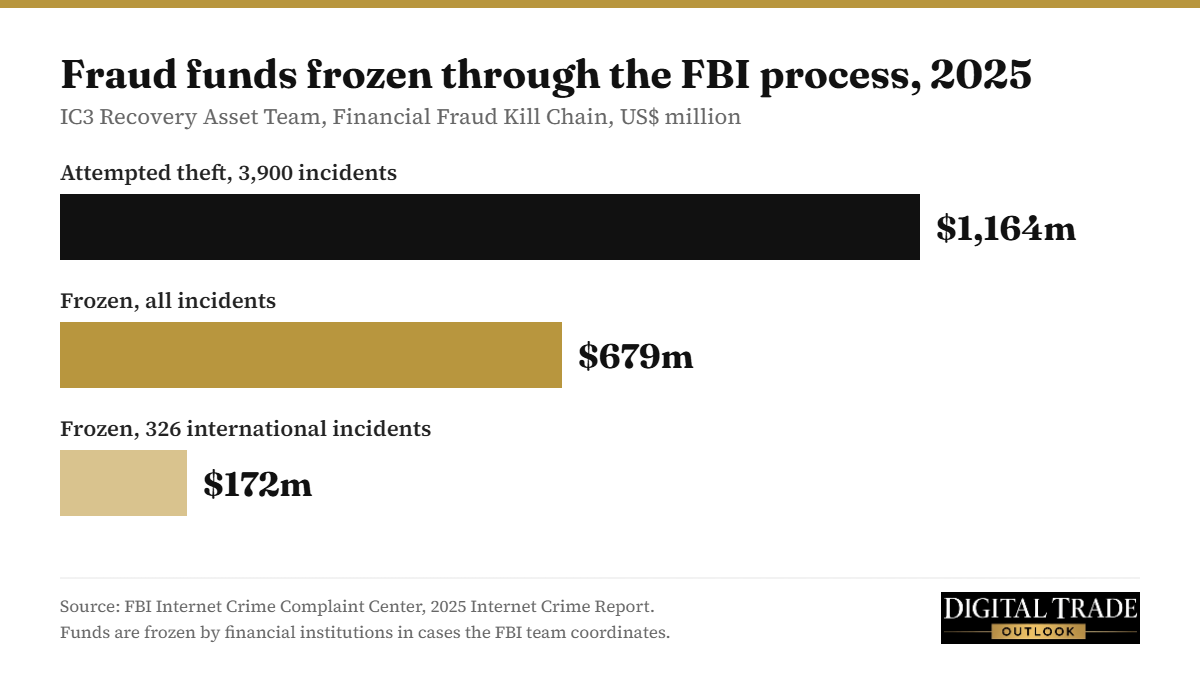
That work matters most in fraud cases. In 2025 the FBI’s Recovery Asset Team worked with banks on 3,900 incidents involving $1.16 billion in attempted theft, and $679 million was frozen, a 58 percent success rate. International transfers made up a small share: 326 incidents, with $172 million frozen. The FBI tells victims to contact their bank immediately and request a recall. Two cautions apply to these figures. Frozen money has not yet been returned to anyone, and the figures measure a law enforcement process rather than Swift’s service.
The new format will help where it can. A camt.056 message must state why the payment is being cancelled, in a far more structured way than the old MT messages, and ISO 20022 has a standard code, FRAD, for payments of fraudulent origin. A receiving bank’s systems can recognise a fraud recall without anyone reading free text. They still cannot pull back money that has already been credited and moved on. A cross-border recall also has to travel back through every bank the payment passed, so it moves only as fast as the slowest bank in that chain.
The date itself could move again. On 27 August Swift extended the structured address migration after several communities asked for more time. A 21 September update then pushed the deferred SR 2026 release, which includes exceptions and investigations messages, to 12 June 2027. For now Swift still lists November 2027 as the end of MT messages for cancellations and investigations, and banks should plan for that date.
The number to watch is how fast banks answer recalls, not how many have switched formats. Swift publishes no figures on recall response times or on how much money is recovered, and until it does, nobody outside the banks can tell whether the migration helps victims. Treasurers do not need to wait for those figures. They can ask their banks now whether they use Stop and Recall, how quickly they send a recall after a fraud report and how they report progress on a case. The answers will show which banks are ready.
Related on Digital Trade Outlook
- When Standards Keep Changing, Will the Cost of Keeping Up Push Smaller Banks Out of Trade Finance?
- Two Months Out, Can Banks Outside the Euro Area Convert and Credit an Instant Euro Payment in 10 Seconds?
- FinCEN Rewrites the Beneficial Owner Rules and Hands Banks More Judgement
Image: Swift logo