



African market knowledge, specialist banking expertise and increasingly capable AI could reshape how trade is financed. The opportunity is to make sound transactions easier to assess, faster to execute and more transparent throughout their lifecycle.
A shipment can cross several borders while the documents needed to finance it are still moving between inboxes. For businesses, that delay can mean tied-up working capital, uncertain delivery schedules and missed opportunities. For banks, it means processing costs and incomplete visibility of the transaction they are being asked to support.
This is where the next competitive advantage in trade finance will emerge: combining an understanding of the market with the ability to connect and interpret information.
At GHIB, technology is increasingly integral to how we differentiate ourselves in the trade finance market. We combine deep African market knowledge and specialist trade finance expertise with advanced digital and AI-enabled tools to make transactions faster, safer and more transparent.
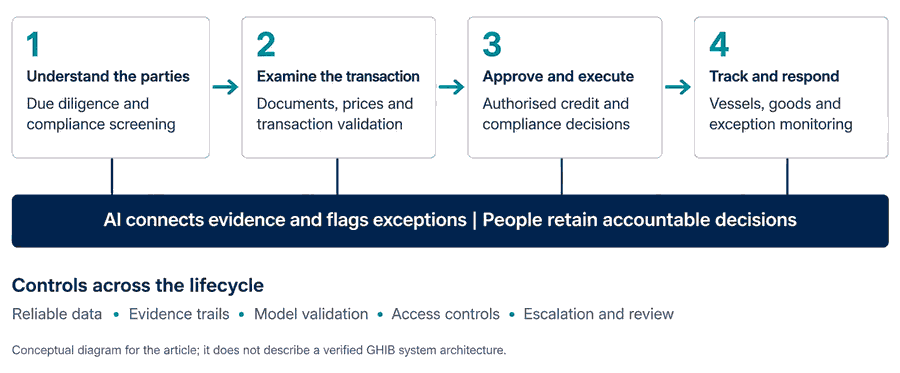
Our technology supports key areas of the transaction lifecycle, including due diligence and compliance screening, document examination and digitisation, price and transaction validation, and the monitoring of vessels and movement of goods. This enables us to reduce manual intervention, strengthen controls and deliver a faster and more consistent service to our clients and correspondent banking partners.
That combination brings our strategic direction and operational expertise together. Technology becomes valuable when it helps a bank understand a transaction more clearly and deliver a dependable service.
A substantial market with unmet demand
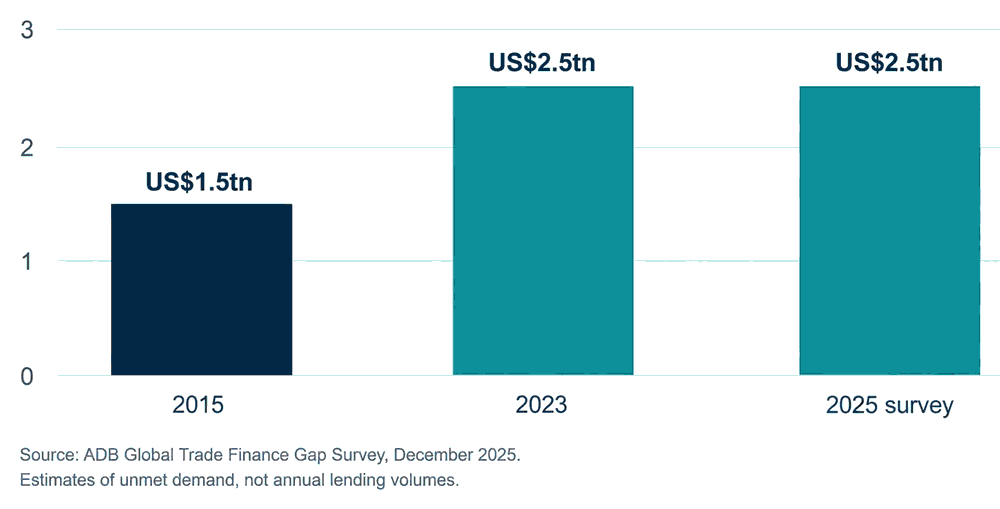
The scale of the opportunity is considerable. The Asian Development Bank’s 2025 survey estimates the global trade finance gap at US$2.5 trillion, unchanged from its 2023 estimate and substantially above the approximately US$1.5 trillion estimated in 2015. The gap represents demand for financing and risk mitigation that financial institutions have not met. [1]
For Africa, the African Development Bank reports unmet demand of US$74 billion to US$92 billion in 2024. This is a significant constraint on businesses seeking to import equipment, secure essential supplies or fulfil export orders. [2]
Unmet demand is not automatically a bankable opportunity. Some applications should be declined. The challenge is to distinguish transactions with unacceptable risks from those constrained by missing information, limited credit capacity or an incomplete understanding of local markets.
For a specialist bank, that distinction is central to both commercial performance and development impact.

Why trade finance is commercially attractive
Trade finance connects banking directly to economic activity: goods are purchased, shipped, delivered and paid for. For clients, it bridges the timing gap between paying suppliers and receiving sales proceeds, while providing greater certainty around cross-border payments.
For banks, its commercial appeal has several dimensions.
Transaction-linked repayment
Many short-term facilities are structured around an identifiable trading cycle, with repayment expected from the proceeds of the underlying transaction. This gives the bank a clear commercial purpose and cash-flow pathway to assess.
At GHIB, we have extensive experience of this approach. Our role in structuring and facilitating finance for Ghana’s cocoa exports illustrates how specialist banking expertise can support a strategically important industry. By connecting international funding with export receivables, these arrangements helped finance the cocoa trading cycle and supported a sector central to Ghana’s economy.
Repeat business and broader relationships
A trading client may need financing alongside payments, foreign exchange and cash management. Meeting these connected needs can build lasting relationships and generate multiple sources of revenue, while deepening the bank’s understanding of the client’s business and financing requirements.
The ability to share risk
Confirmations, guarantees and risk participations enable several institutions to support a transaction, subject to their respective eligibility requirements and risk appetite. This can expand financing capacity while limiting the exposure retained by any single institution.
Ghana’s cocoa syndications during the first two decades of this century provide a compelling example. Major international banks combined their funding capacity through billion-dollar syndicated facilities structured around cocoa exports and the resulting receivables. These arrangements enabled participating banks to share risk while providing substantial financing for the sector.
GHIB is increasingly extending this model to other emerging markets, adapting its structuring expertise to the needs of sovereign and corporate clients. The objective is to connect identifiable trade flows and repayment sources with international funding, using partnerships to deliver greater financing capacity than one institution could provide alone.
An opportunity to improve the economics of smaller transactions
When processing and control costs fall, transactions that were previously expensive to service may become more commercially viable.
These attractions depend on disciplined structuring and execution. Fraud, documentary discrepancies, sanctions exposure, country risk and payment delays remain material considerations. Short tenor and supporting documents do not remove those risks.
The ICC’s 2025 Trade Register commentary reinforces the importance of distinguishing between products: their default experience varies, and aggregate figures can conceal differences between exposure-weighted and transaction-weighted outcomes. [3]
The commercial question is therefore how to originate, assess and service appropriate transactions at a sustainable return. AI could change that calculation.
Unmet demand is not automatically a bankable opportunity.
Ian Greenstreet and Anis Ahsan
From documents to connected intelligence
Much of trade finance involves reconciling different versions of the same commercial story.
Does the invoice match the purchase order? Are the goods, quantities and shipment details consistent? Does the price warrant further investigation? Are the parties and payment instructions credible? Has a change in the vessel’s journey introduced a new concern?
Digitisation makes information easier to access. More capable AI could help connect that information and identify inconsistencies across documents, counterparties and physical trade flows.
Consider an illustrative transaction in which the documents appear internally consistent, but the vessel’s movements conflict with the stated shipment route. A connected system could bring that discrepancy to an analyst’s attention, together with the relevant evidence. The analyst could then investigate before the bank proceeds.
The value lies in directing expert attention towards material exceptions, while reducing repetitive work.
The value lies in directing expert attention towards material exceptions, while reducing repetitive work.
Ian Greenstreet and Anis Ahsan
Preparing for more capable AI
The prospect of artificial superintelligence, meaning systems that exceed human capabilities across a broad range of tasks, raises a larger question: how much of a trade transaction could eventually be assessed as a connected whole?
There is no reliable timetable for such a development. Banks can nevertheless prepare for progressively more capable AI.
One possible direction is towards systems that continuously combine commercial documents, counterparty information, pricing evidence and logistics data. Instead of completing a series of disconnected checks, they could maintain an evolving assessment of a transaction and explain why a new development requires attention.
More capable systems might also help bankers evaluate alternative structures: whether additional confirmation, a guarantee, a shorter tenor or a different payment arrangement could make a transaction acceptable.
These are potential developments, not claims that autonomous credit judgement is ready for unrestricted deployment. The quality of the underlying information, the ability to validate conclusions and clear accountability would remain fundamental.
Our view is that the strongest banks will use increasingly capable AI to extend the reach of their specialists while retaining control over decisions and commitments.
AI could expand the trade opportunity
The implications extend beyond banking operations.
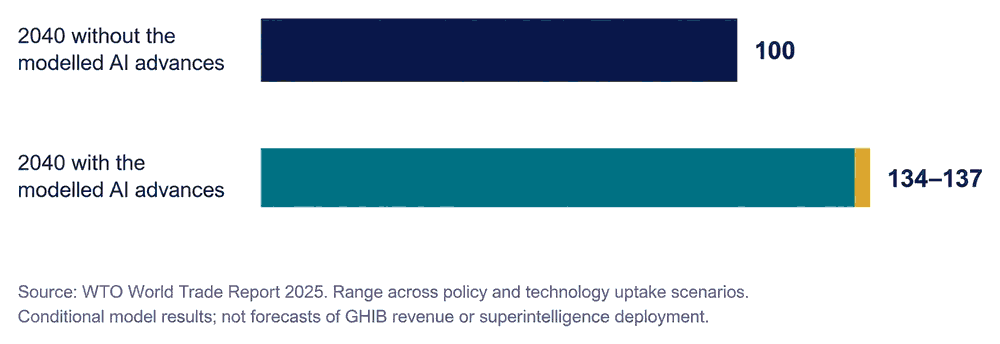
The WTO’s World Trade Report 2025 models scenarios in which AI could increase global trade by 34% to 37% by 2040, compared with a world without those AI-driven advances. The projected gains reflect lower trade costs, productivity improvements and growth in tradable AI services. They depend on how technology spreads and on supporting policy choices. These are AI scenarios, rather than predictions about superintelligence. [4]
The Accra Convention opens new possibilities
This discussion comes at a particularly timely moment. The United Nations Convention on Negotiable Cargo Documents, known as the Accra Convention, opened for signature in Accra on 26 October 2026, when 26 countries signed it. It creates a framework for extending the benefits of negotiable transport documents, long established in maritime shipping, to road, rail, air and multimodal transport, in both paper and electronic form. [5]
As the Convention enters into force and is adopted in practice, it could simplify transactions, reduce reliance on paper and make it easier for businesses to obtain financing against goods in transit. For Africa, where road and rail connections are essential to regional trade and access to landlocked markets, this could significantly broaden the range of transactions supported by negotiable cargo documents.
AI could help banks assess these transactions at greater scale and speed. By examining documents, checking consistency across commercial and logistics information, and flagging discrepancies for specialist review, it could reduce processing friction and help identify bankable transactions. The combination of stronger legal foundations and more capable technology could expand access to trade finance while strengthening the controls on which lenders depend.
For banks, this suggests two potential opportunities: improving the efficiency of financing existing trade and supporting new trade flows as businesses become more productive and reach additional markets.
For African institutions, participation will depend on access to reliable data, digital infrastructure and the skills needed to use these tools effectively. Local market understanding will remain important, particularly where information is incomplete or commercial practices require context.
GHIB as a bridge between markets
GHIB’s position as a UK-regulated bank with deep African relationships gives us a practical role in connecting these developments.
Our market knowledge helps us understand counterparties and trade flows. Our partnerships with banks across Africa and leading international correspondent banks allow GHIB to connect African trade with global financial markets. Our specialist expertise helps us structure transactions. Technology supports the analysis, controls and execution needed to serve clients and international banking partners.
Risk-sharing partnerships add another dimension. GHIB’s confirming bank agreement with the African Development Bank under its Trade Finance Transaction Guarantee Instrument supports eligible transactions involving approved African issuing banks, expanding the capacity available to facilitate trade. [6]
The next phase of trade finance will reward institutions that can bring these capabilities together consistently. Clients will judge progress through practical outcomes: clearer requirements, timely decisions, dependable payments and better visibility of their transactions.
For GHIB, intelligent banking means applying technology to the work that matters: understanding African trade, managing its risks and connecting viable opportunities with international financial capacity.
About the authors
Ian Greenstreet · Chief Executive Officer, Ghana International Bank Plc
More than 40 years of international experience across banking, investment management, corporate finance and risk management, with senior leadership and board roles at financial institutions in Europe and Africa. At GHIB, he leads the Bank’s growth strategy.
Anis Ahsan · Head of Trade Operations, Ghana International Bank Plc
More than 40 years of international banking experience across the UK, GCC and EMEA, spanning trade finance and transaction banking, business growth, operating model transformation and digital trade platforms.
Sources
- Asian Development Bank, ADB Global Trade Finance Gap Survey, December 2025
- African Development Bank, trade finance report findings, 2026
- International Chamber of Commerce, ICC Trade Register 2025 Market Commentary
- World Trade Organization, Harnessing AI for inclusive growth, 29 September 2025; World Trade Report 2025
- United Nations, Convention on Negotiable Cargo Documents and treaty status
- African Development Bank, GHIB confirming bank agreement announcement, 19 June 2026
Outlook Op-Ed pieces are written by invited industry leaders. Views expressed are the authors’ own and do not necessarily reflect those of Digital Trade Outlook.
Related on DTO: What is MLETR? · MLETR Adoption Tracker · What is Project mBridge?