
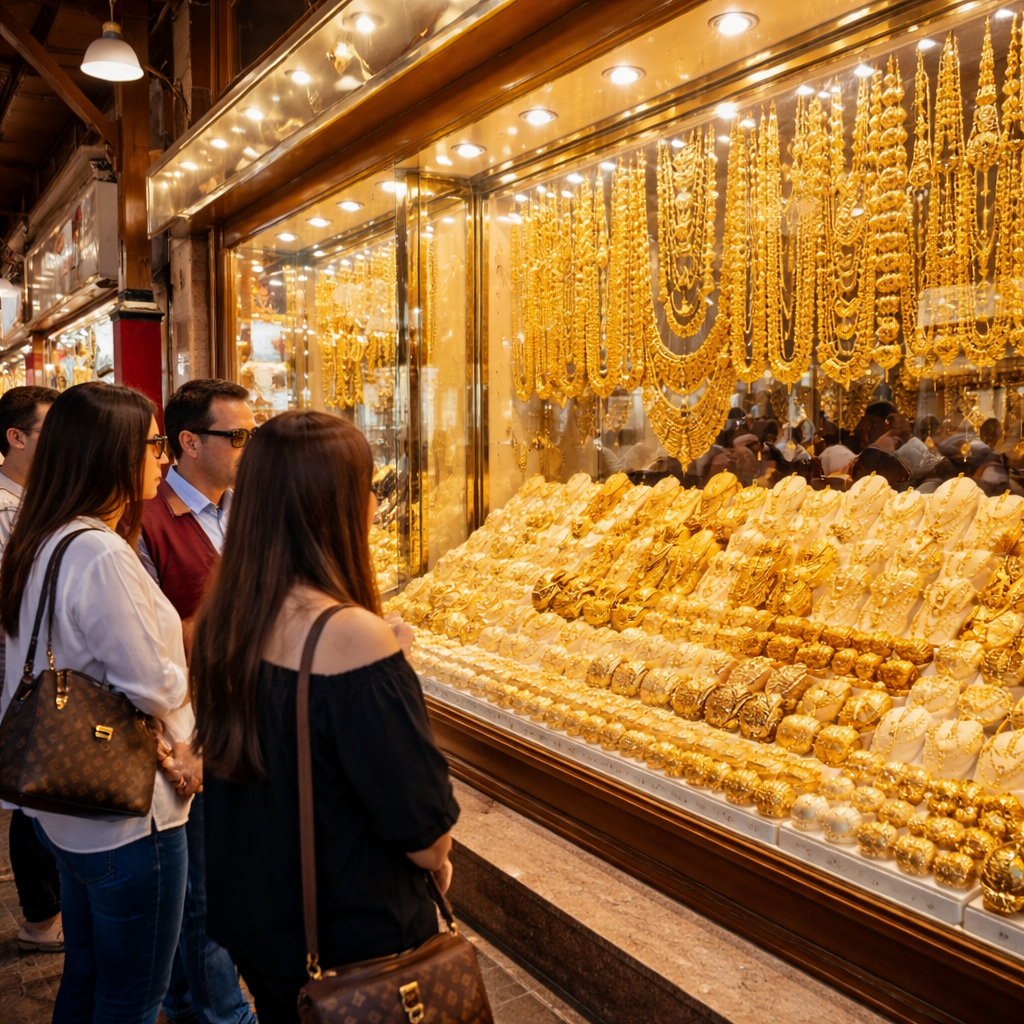
Dubai’s retail gold market is witnessing a rise in selling activity as expatriate communities from South and Southeast Asia liquidate portions of their gold holdings amid escalating geopolitical tensions in West Asia and shifting currency dynamics, according to traders and industry observers.
Bullion traders operating in Dubai’s Gold Souk say members of the Indian, Pakistani, Bangladeshi, Sri Lankan, Nepali, Filipino, Indonesian and Malaysian diaspora have increasingly approached jewellery stores to sell small quantities of jewellery and gold bars in recent weeks.
Retailers say many customers are converting gold assets into cash that can be transferred quickly to families in their home countries. In some cases, bullion bars are being exchanged for jewellery that is easier to carry under international travel baggage rules.
Liquidity and Risk Diversification
Market analysts note that gold often serves as a financial buffer for migrant communities working in the Gulf region. During periods of geopolitical uncertainty or currency volatility, households tend to liquidate a portion of their bullion holdings to maintain cash reserves or diversify savings.
Unlike physical gold, which requires transport or resale logistics, cash proceeds can be transferred quickly through formal banking and remittance channels.
Retailers report that much of the selling activity involves small quantities of jewellery accumulated over time as savings by migrant workers and small business owners.
Secondary Market Activity
Independent jewellers and bullion traders in Dubai’s traditional trading districts are currently buying back gold at slight discounts to prevailing market prices, typically between 4% and 5%, depending on purity and documentation.
Dubai’s active secondary gold market allows traders to recycle gold supply through refining and resale within the regional bullion trade.
Large jewellery chains, however, tend to restrict buybacks to products originally purchased from their own outlets.
Geopolitical Tensions Driving Market Behaviour
Analysts say the ongoing military confrontation involving the United States, Israel and Iran has added to financial uncertainty across the Middle East and global commodity markets.
The conflict has already disrupted aviation routes and cargo logistics in parts of the Gulf region, affecting the movement of bullion shipments and broader commodities trade.
Escalating tensions around the Strait of Hormuz, a key global energy corridor, have also triggered volatility in oil and financial markets, raising concerns about prolonged regional instability.
Remittance and Currency Factors
Currency movements are also influencing decisions to sell gold. The UAE dirham’s peg to the US dollar means fluctuations in South Asian currencies can increase the relative value of remittances sent from the Gulf.
Banking and remittance operators say proceeds from gold sales are frequently transferred through formal financial channels to countries such as India, Pakistan, Bangladesh, Sri Lanka, Nepal and the Philippines, which are among the largest recipients of remittances from Gulf economies.
Cross-Border Payment Flows
Industry observers say the conversion of physical gold into cash is also feeding into cross-border financial flows between the Gulf and major remittance corridors in South and Southeast Asia. Funds generated from gold sales are typically transferred through banking channels and regulated remittance services, allowing expatriate workers to send liquidity quickly to families in their home countries. Analysts note that during periods of geopolitical uncertainty, such movements illustrate how traditional stores of value such as gold can rapidly be converted into transferable funds moving through the region’s cross-border payments network.
Outlook
Market observers say if the US–Israel–Iran conflict continues for an extended period, selling activity in Dubai’s retail gold market could increase further as expatriate households prioritise liquidity.