

By Digital Trade Outlook Editors · Last updated 30 October 2026
Project mBridge is a shared ledger on which commercial banks settle cross border payments in central bank digital currency. Payments and FX trades settle directly between banks, in seconds, without a correspondent chain. Five years after launch the platform works and is growing fast. Almost all of its value, though, moves in one currency: China’s digital renminbi.
The numbers
| 2022 pilot | To end November 2025 | |
|---|---|---|
| Period | 15 Aug to 23 Sep 2022 | Cumulative |
| Transactions | 164 | 4,047 |
| Value | US$22.1 million | RMB 387.2 billion (about US$55.5 billion) |
| Digital renminbi share | Largest by transaction count | 95.3% of value |
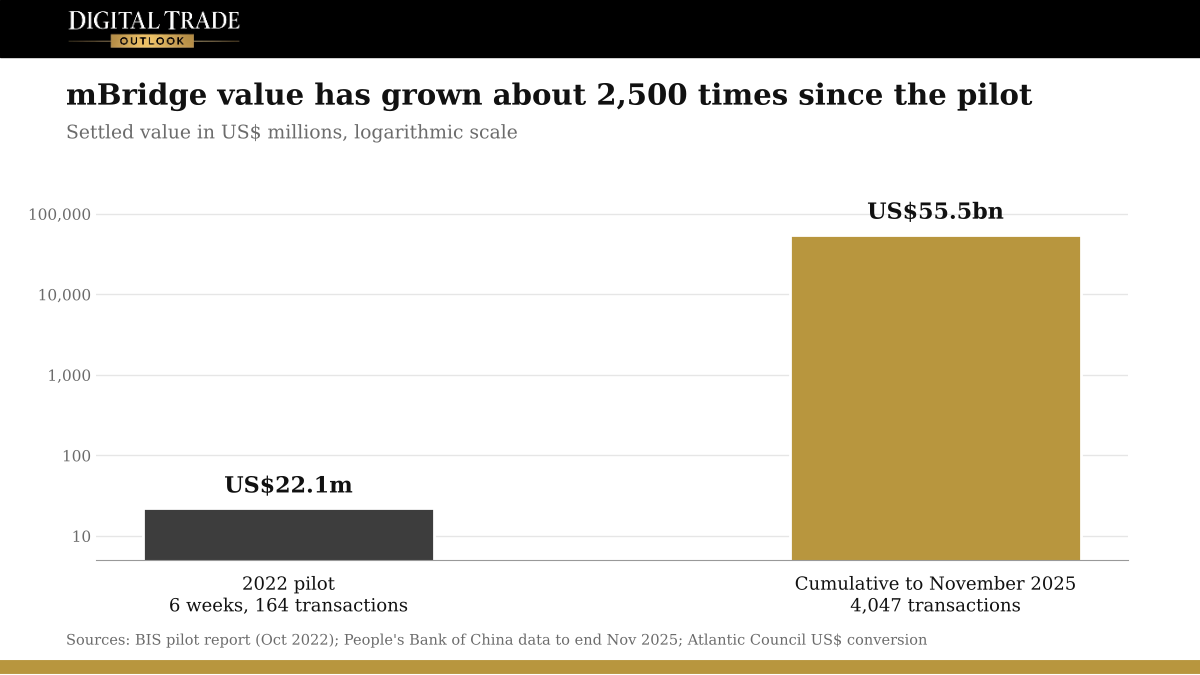
Value grew about 2,500 times in three years. In June 2026 the Financial Times, citing unnamed sources, put the cumulative total at about RMB 470 billion. No member central bank has confirmed that number.
How it works
Each member central bank issues a wholesale digital form of its currency onto the ledger. Only its own domestic banks can create or redeem it against their reserves, so no country’s monetary base changes. Once the currency is on the ledger, banks in other member jurisdictions can hold it and pay each other directly.
FX settles payment versus payment: both legs complete together, or neither does. Settlement is final when the ledger records it. Each founding central bank runs a validating node. Each also sets its own controls: which banks may hold its currency, how much, for how long, and against which currency pairs.
The case for this design is cost and risk. The BIS noted that correspondent payments can take three to five days to settle. Citing an Oliver Wyman and J.P. Morgan study, it put transaction fees on roughly US$23.5 trillion of cross border flows in 2020 at about US$120 billion, before FX costs.
Who is on it
| Central bank | Status |
|---|---|
| Hong Kong Monetary Authority | Founding member |
| Bank of Thailand | Founding member |
| Digital Currency Institute, People’s Bank of China | Member since 2021; leads technology |
| Central Bank of the UAE | Member since 2021 |
| Monetary Authority of Macao | Full member since June 2026 |
| Saudi Central Bank | Joined 2024; left after its proof of concept ended on 13 May 2025 |
| BIS Innovation Hub | Coordinator until October 2024, then handed over |
The pilot used 20 banks, five per jurisdiction:
| Hong Kong | Mainland China | Thailand | UAE |
|---|---|---|---|
| Bank of China (Hong Kong) | Agricultural Bank of China | Bangkok Bank | Bank of China, Abu Dhabi |
| Bank of Communications | Bank of China | Bank of Ayudhya | First Abu Dhabi Bank |
| ICBC (Asia) | Bank of Communications | Kasikornbank | HSBC Bank Middle East |
| Standard Chartered | China Construction Bank | Siam Commercial Bank | ICBC, Abu Dhabi |
| HSBC | ICBC | HSBC, Bangkok | Standard Chartered (UAE) |
Macao added 11 approved banks in June 2026. On the first day, three of them completed 23 transactions worth nearly MOP 13 billion, according to the Monetary Authority of Macao.
What the data shows
1. The renminbi led on activity from the start. In the 2022 pilot, digital renminbi was already the most used currency by number of transactions. By value, the UAE dirham was larger, because all its transactions were interbank. The People’s Bank of China connected mBridge directly to its live domestic e-CNY system, while the other central banks issued and redeemed their currencies manually.
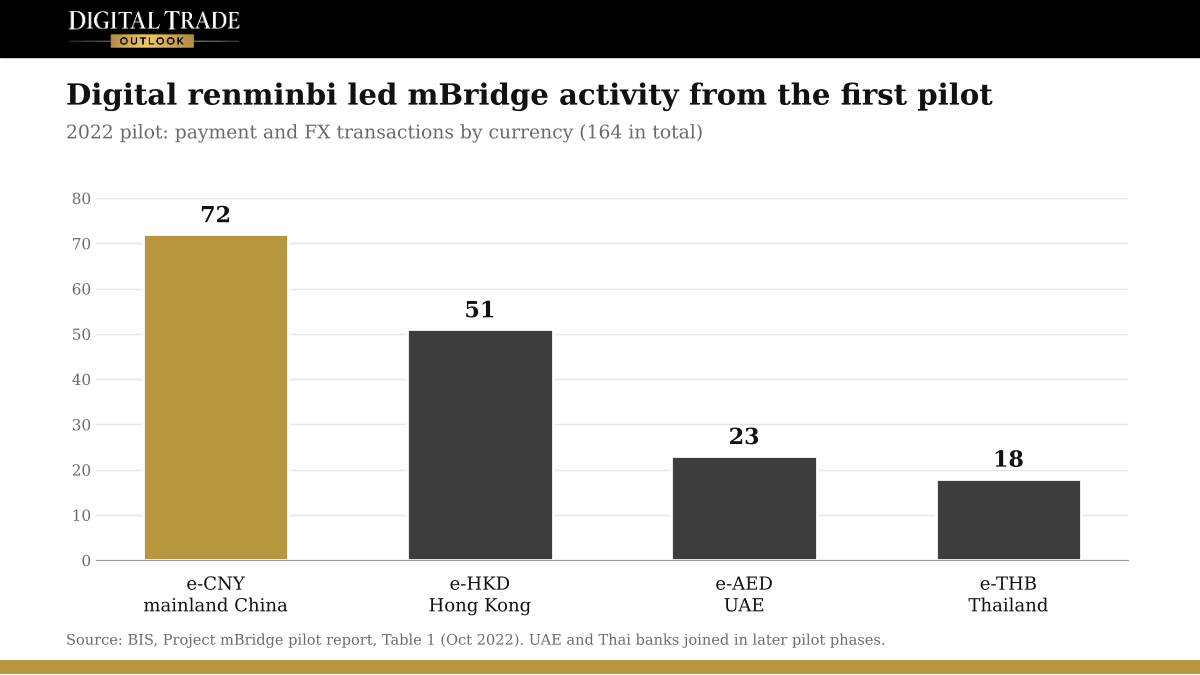
By November 2025, digital renminbi carried 95.3 per cent of value. The platform was designed for many currencies. In practice it is a channel for China’s payments with Hong Kong, Macao and the Gulf.
2. Liquidity, not technology, is the constraint. Only 32 of the 164 pilot transactions were FX trades. FX was priced off the ledger, and Thai baht had to be cleared off the platform each day. So most banks bought foreign currency from their existing nostro balances instead of trading it on mBridge. A multi currency rail needs market makers quoting each pair on the ledger. Until they arrive, correspondent accounts stay in use alongside it.
3. The trade base is large, but invoicing has not moved. The original four jurisdictions traded US$563.6 billion with each other in 2021 and accounted for 19 per cent of world merchandise trade. The BIS noted that this regional trade was still settled mainly in foreign currencies. Shifting that invoicing, not adding banks, is what would change mBridge’s scale.
4. Membership has moved towards China. The BIS stepped back in 2024. Saudi Arabia, the largest Gulf economy on the platform, left in 2025. Macao, which is part of China, joined in 2026. Every membership change since the pilot has tied the platform more closely to Beijing.
What to watch
- A second currency with real volume. If UAE dirham or Thai baht flows grow, mBridge becomes a multi currency network. If they don’t, it stays a renminbi rail.
- FX liquidity on the ledger. Market makers quoting pairs on the platform would remove the main practical limit the pilot exposed.
- Governance of the commercial operator. In June 2026 the Financial Times reported plans to run mBridge through an entity in Hong Kong. Banks outside China’s orbit will judge the platform by who owns that entity and how it admits members.
- The next full member. More than 30 central banks and international bodies were observing when the BIS stepped back. A non Chinese jurisdiction joining with live volume would be the clearest sign of where mBridge is heading.
Related on Digital Trade Outlook
- China Moves Toward Commercial Launch of mBridge Cross Border Payments Platform
- Is Local Currency Trade Replacing the Dollar, or Just Routing Around It?
- Standard Chartered China among first foreign banks to sign CBETS Direct Participant Agreement