
By Digital Trade Outlook Editors · Last updated 17 October 2026
MLETR is the UNCITRAL Model Law on Electronic Transferable Records, adopted by the UN Commission on International Trade Law on 13 July 2017. It lets an electronic record do the legal job of a paper trade document such as a bill of lading, bill of exchange, promissory note or warehouse receipt. It is a template, not a treaty: it has effect in a country only once that country writes it into national law.
Key facts
- Adopted by UNCITRAL: 13 July 2017
- Jurisdictions with MLETR-based law: 13, according to UNCITRAL
- UK Electronic Trade Documents Act: in force since 20 September 2023
- First EU adopter: France, through a June 2024 law
- Carrier target: 100% electronic bills of lading by 2030 (DCSA members)
In this explainer
- Why has paper been so hard to replace?
- What does MLETR actually do?
- Paper vs electronic documents
- Which countries have adopted MLETR?
- Is shipping ready for electronic bills of lading?
- How does MLETR affect trade finance?
- What are the limits of MLETR?
Why has paper been so hard to replace?
A bill of lading is not just a receipt for cargo. Whoever holds the original controls the goods, can sell them in transit, and can pledge them to a bank as security for finance. Bills of exchange and promissory notes work the same way: the holder of the original has the right to be paid.
Most national laws tie those rights to physical possession of a unique paper document. An email or PDF can be copied endlessly, so on its own it cannot prove who holds the one original. As a result, banks, carriers and insurers have kept couriering stacks of paper long after the rest of trade went digital.
Platforms built workarounds, mainly closed rulebooks that bind every user by contract. These work between members but give no protection against outsiders, courts or parties who never signed up.
What does MLETR actually do?
MLETR solves the possession problem without rewriting trade or banking law. Its core idea is functional equivalence: an electronic record can meet any legal requirement for a paper transferable document, provided it meets the model law’s conditions.
In place of possession, it uses control. Whoever controls the electronic record holds the rights a paper holder would have. To make that work, the system must identify one authoritative record, protect it from unauthorised change, and show clearly who controls it at any time.
MLETR does not prescribe a technology. It asks only that the method used be reliable, so a blockchain, a central registry or another platform can all qualify. Nor does it change the substance of trade law: who may claim the goods, or what happens when a bill of exchange is dishonoured, stays the same. Only the medium changes.
Paper vs electronic documents
| Paper document | Electronic record under MLETR-style law | |
|---|---|---|
| Who holds the rights | Whoever physically holds the original | Whoever has control of the record |
| How it is transferred | Endorsed and couriered | Control passed through a reliable system |
| Proof of a single original | The physical paper | System identifies one authoritative record |
| Legal basis | Long-standing national law | National law based on MLETR |
Which countries have adopted MLETR?
According to UNCITRAL’s status page, legislation based on or influenced by MLETR has been adopted in 13 jurisdictions.
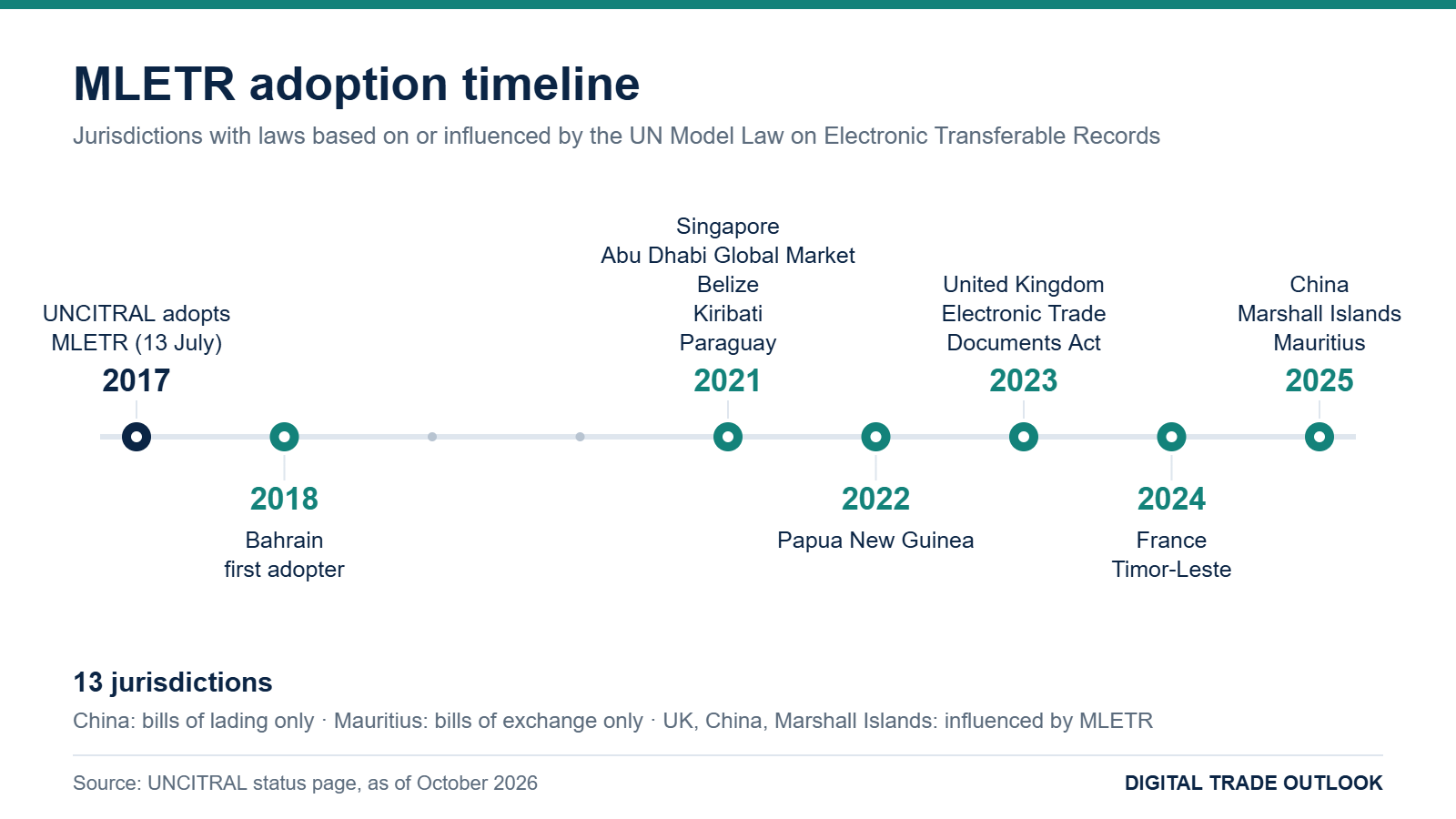
The UK’s Electronic Trade Documents Act 2023 matters most for trade finance because so many trade contracts are governed by English law. France became the first EU member state to adopt it, through Law No. 2024-537 of June 2024, followed by an implementing decree on reliable systems, No. 2025-811, in August 2025.
| Jurisdiction | Year |
|---|---|
| China (bills of lading only) | 2025 |
| Marshall Islands (influenced by MLETR) | 2025 |
| Mauritius (bills of exchange only) | 2025 |
| France | 2024 |
| Timor-Leste | 2024 |
| United Kingdom (influenced by MLETR) | 2023 |
| Papua New Guinea | 2022 |
| Singapore | 2021 |
| UAE: Abu Dhabi Global Market (free zone) | 2021 |
| Belize | 2021 |
| Kiribati | 2021 |
| Paraguay | 2021 |
| Bahrain | 2018 |
Others are moving. FIATA, citing the ICC Digital Standards Initiative, reported in September 2025 that 61.5% of global exports came from economies aligned with or committed to MLETR. Japan’s government plans to submit a Commercial Code amendment to digitise bills of lading to the extraordinary Diet session, Kyodo reported on 11 October 2026; it has not yet been enacted. According to FIATA, the African Continental Free Trade Area has also included an MLETR commitment in its Digital Trade Protocol.
Is shipping ready for electronic bills of lading?
Carriers are moving too. In February 2023 the nine ocean carrier members of the Digital Container Shipping Association, including MSC and Maersk, committed to issuing 50% of bills of lading electronically within five years and 100% by 2030, based on DCSA standards.
Law and carrier practice have to move together. An electronic bill of lading is of limited use if the law governing the trade does not recognise it, and a law is of limited use if carriers keep issuing paper.
How does MLETR affect trade finance?
The biggest change is to security. Where MLETR-style law applies, a bank taking an electronic bill of lading as collateral has the same legal position as with paper. Without such law, that position rests only on a platform contract.
It also leaves less room for double financing. Singapore oil trader Hin Leong, which collapsed in 2020 with liabilities of about $3.5 billion, sold the same inventory to multiple parties, leading to competing legal claims on the same cargo, S&P Global reported. A single controlled electronic record makes that harder. In Bahrain, the first MLETR adopter, BENEFIT is rolling out a trade finance registry that lets banks check invoices against each other to catch the same invoice being financed twice.
Speed and automation follow. Electronic documents move between seller, bank and buyer instead of by courier, which reduces the risk of cargo reaching port before its papers. Once documents are data, checks and financing decisions can be automated: Mizuho’s move onto Traydstream’s document-checking platform brought all three Japanese megabanks onto it, even before Japan’s eBL law is in place.
Governing law decides it in practice. A transaction is covered only if the law that governs the document recognises electronic records, which is why the UK act carries so much weight beyond Britain.
What are the limits of MLETR?
Coverage is still patchy. Thirteen jurisdictions is a small share of trading nations, and a trade can still pass through a country whose law requires paper. Some adoptions are partial: according to UNCITRAL, China’s law covers only bills of lading and Mauritius’s only bills of exchange, so a full set of trade documents may not all qualify.
Legal recognition also does not make systems talk to each other. A valid electronic record still has to move between competing platforms, and carriers, banks and traders often use systems that do not connect.
Finally, practice lags the law. Banks, insurers and customs authorities must change internal rules built around paper, and payment and financing steps can stay manual even when documents go digital. That limits the time saved.
Further reading on DTO
- Paperless trade gains momentum as governments push digital trade documentation
- NBB signs up first for Bahrain’s trade finance registry, a shared check against double financing
- Mizuho selects Traydstream, bringing all three Japanese megabanks onto TraydCheck
- ASEAN’s DEFA moves digital trade rulemaking beyond the WTO
Sources: UNCITRAL status page · UN Information Service, 2017 · legislation.gov.uk: Electronic Trade Documents Act 2023 · Légifrance: Law No. 2024-537 · Decree No. 2025-811 (via ICC France) · FIATA · Kyodo via Ryukyu Shimpo · DCSA · Container News · S&P Global on Hin Leong
Image: John Fielding, CC BY 2.0, via Wikimedia Commons