
Most of the noise in payments is about what’s new: real-time rails, digital assets, wallets. Mehta’s work is about driving the shift of cross-border payments to meet the demands of the always-on payments world. Updating legacy systems while they’re still running. Driving payment data into one format across countries that each keep their own rulebook. All without clients experiencing disruption.
Ask him why a cross-border payment still can’t feel like a domestic one and he doesn’t point at technology. He points at the absence of a common framework, and the fact that closing that gap needs coordination nobody has built yet.
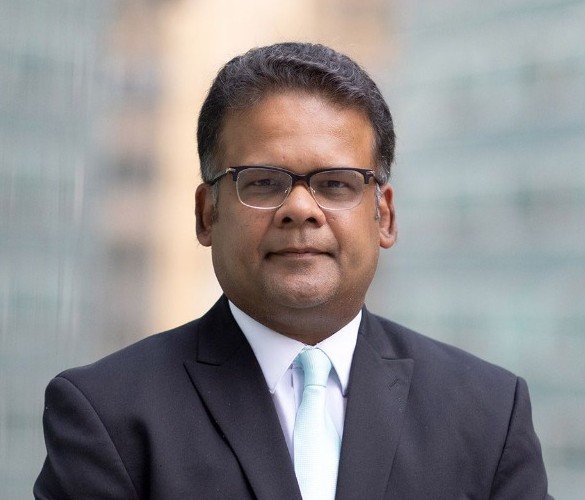
Jiten Mehta, Global Business Execution Head – Cross-Border & Instant Payments Modernization (Payments Express) at Citi, spoke to Digital Trade Outlook about what separates a transformation that scales from one that stalls, what a global network of Citi’s size actually does for clients, and how moving money is about to change.
Digital Trade Outlook–Cross-border and instant payments modernization has become a defining priority for global transaction banks. Leading business execution for this agenda, what does modernization actually involve day to day, beyond the headlines?
Jiten Mehta, Global Business Execution Head – Cross-Border & Instant Payments Modernization (Payments Express), Citi: Beyond the headlines, day-to-day modernization involves the intricate work of decommissioning legacy systems and migrating services without disruption. It means standardizing vast amounts of payment data to formats like ISO 20022 to improve analytics and efficiency. Teams focus on building and refining APIs for real-time connectivity, enhancing security protocols to counter evolving fraud threats, and navigating the complex web of regulatory compliance across multiple jurisdictions.
Increasingly, it also means building infrastructure for an always-on, 24/7 payments environment where clients expect real-time visibility, faster access to liquidity, and seamless connectivity across payment networks. It is a continuous cycle of agile development, rigorous testing and incremental deployment to upgrade the core payment processing engines.
Instant payments adoption varies widely across markets. What remains the biggest barrier to making cross-border payments feel as seamless as domestic ones?
The biggest barrier remains the fundamental lack of a single, universal regulatory framework and set of payment standards. Each country operates its own domestic payment system, with unique compliance rules (like AML/KYC), data privacy laws, and operating hours. This global fragmentation creates friction and complexity at each “hop” a payment makes, impacting liquidity management, foreign exchange, and error resolution.
The challenge is no longer just moving money across borders, but creating interoperability between domestic instant payment schemes, card networks, digital wallets, and emerging digital asset ecosystems. While initiatives like SWIFT are creating bridges, achieving true seamlessness requires much deeper international coordination.
“The challenge is no longer just moving money across borders, but creating interoperability between domestic instant payment schemes, card networks, digital wallets, and emerging digital asset ecosystems.”
You have spent nearly two decades across capital markets, wealth management and commercial banking before moving into payments. How has that breadth shaped the way you approach payments transformation?
This broad experience provides a crucial, holistic view of a client’s entire financial lifecycle, where payments are not a standalone product but an integral component. Understanding the end-to-end client journey, from a trade settlement in capital markets to a supply chain payment in commercial banking, helps in designing solutions that are context-aware and solve real-world business problems.
It reinforces that payments, liquidity, FX, financing, and treasury activities are increasingly interconnected and need to operate as part of a seamless client experience. It fosters a deeper appreciation for the interconnectedness of data, liquidity, and risk management, ensuring that transformation is driven by client outcomes, not just technology.
Large-scale modernization programmes often stall between pilot and production. What execution disciplines make the difference between a transformation that scales and one that stays a proof of concept?
Successful scaling starts with solving real client needs and hinges on a modular architecture with a clear, phased roadmap that delivers incremental value. The key disciplines include rigorous program governance, establishing clear business-driven goals from the start, and securing strong executive sponsorship to overcome organizational inertia.
Crucially, creating a reusable “factory” model for migrating markets or products onto the new platform prevents each deployment from becoming a new, bespoke project, enabling both speed and consistency.
“A reusable ‘factory’ model prevents each deployment from becoming a new, bespoke project.”
Citi operates one of the most extensive proprietary payment networks in global banking. What does that scale and network reach make possible for clients in cross-border payments that would be difficult to replicate elsewhere?
Citi’s extensive network allows us to act as a single, consistent counterparty for clients across tens of countries, minimizing reliance on complex intermediary bank chains. This provides clients with greater predictability in payment timing and costs, and simplifies liquidity management by offering a unified view of their global cash positions.
Direct control over the payment flow enables richer data services, enhanced security, and more efficient compliance screening, making it possible to offer solutions that are difficult to replicate. Clients are looking for more speed, transparency, and resiliency in cross-border payments, and operating at global scale allows us to deliver a more seamless experience. It also enables clients to move funds globally with integrated FX capabilities and increasing access to real-time payment experiences across accounts, wallets, and cards.
Ultimately, modernization only matters if clients feel the difference. What changes should corporate and institutional clients expect in how they experience cross-border payments over the next few years?
Clients should expect a significant shift from simple payment execution to receiving data-rich insights and value-added services. Payments will become more deeply embedded into their treasury and ERP systems via APIs, enabling real-time initiation, tracking, and automated reconciliation. They will increasingly expect payments to be seamless, invisible, and integrated into broader business workflows rather than treated as a standalone activity.
They will experience radical transparency with end-to-end tracking and predictable settlement times, similar to a modern logistics service. Ultimately, the experience will feel less like a series of manual instructions and more like an automated, intelligent part of their financial workflow.
“The experience will feel less like a series of manual instructions and more like an automated, intelligent part of their financial workflow.”
Over time, we are also likely to see greater interoperability between traditional payment rails, instant payments, and digital asset-based infrastructure, giving clients more flexibility in how they move and manage money globally.