
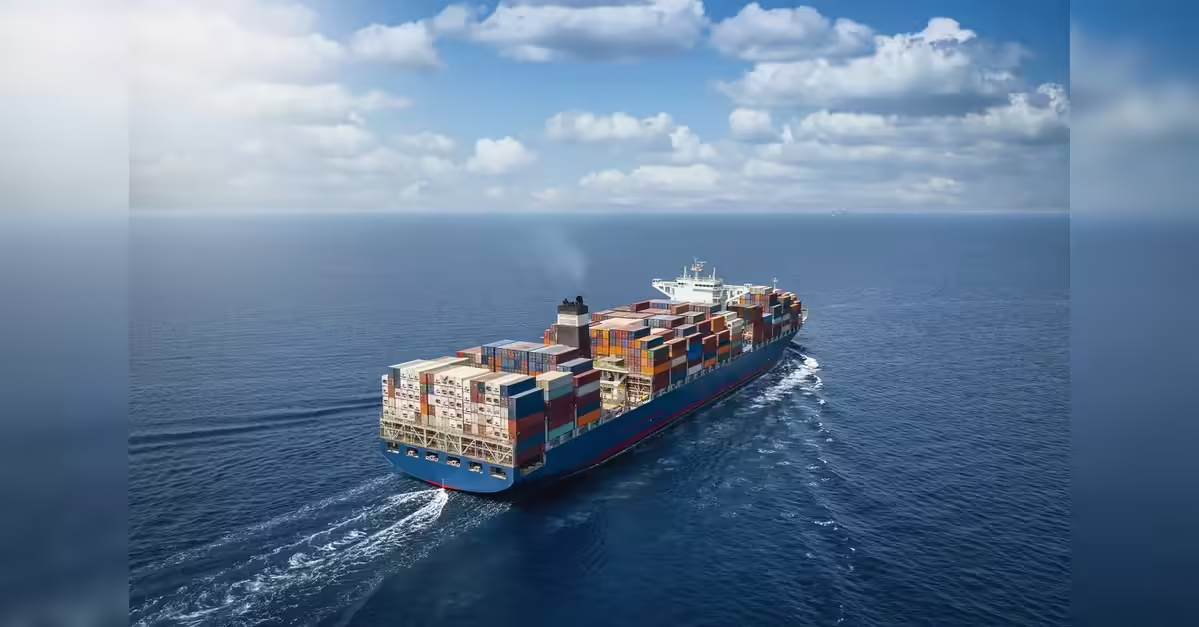
March 27, 2026: Ports across Europe and Asia are ramping up investments in clean energy and low-carbon infrastructure, as the global shipping industry faces intensifying pressure to cut emissions while managing rising costs and supply chain disruptions.
The shift marks a structural change in maritime trade, with ports moving beyond their traditional role as cargo hubs to emerge as integrated energy and logistics centres supporting alternative fuels and decarbonised shipping. Shipping accounts for roughly 3% of global emissions, according to estimates cited by Reuters. Industry bodies including the International Maritime Organization have set targets to cut total greenhouse gas emissions from shipping by at least 50% by 2050 compared to 2008 levels, placing the sector under growing regulatory and investor scrutiny.
Europe Tightens Policy Push
The European Commission in March outlined its EU Ports Strategy, aimed at strengthening competitiveness while accelerating the bloc’s transition to climate-neutral shipping. The plan focuses on faster approvals for energy projects, expansion of shore power infrastructure, and development of fuel hubs for hydrogen, ammonia and methanol.
Some of Europe’s largest ports are already moving ahead. The Port of Rotterdam is scaling up hydrogen infrastructure as part of its long-term energy transition strategy, while the Port of Antwerp-Bruges is investing across multiple fuel pathways, reflecting continued uncertainty over which technologies will dominate.
At the same time, environmental concerns continue to add urgency. A report cited by The Guardian recently highlighted that ferry emissions remain a significant contributor to air pollution in several European port cities.
Asia Expands Projects and Partnerships
In Asia, the transition is being driven by a mix of state-backed investment, industrial policy and cross-border collaboration. Singapore is expanding its network of green and digital shipping corridors, linking major ports across Asia and beyond.
One of the most closely watched initiatives is the Rotterdam–Singapore corridor. The project aims to deploy low- and zero-carbon fuels along a key global trade route, positioning it as a potential blueprint for future intercontinental green shipping lanes.
China has also stepped up green shipping initiatives, while India is advancing port decarbonisation under its green port framework, including plans to develop hydrogen-linked infrastructure. Ports such as Deendayal Port, V.O. Chidambaranar Port and Paradip Port are part of these efforts. Japan and South Korea are also investing in alternative fuels such as LNG and methanol, alongside shore power systems.
Financing the Transition: Banks and Trade Finance Step In
Behind the infrastructure push, banks and financial institutions are playing an increasingly central role in funding port decarbonisation and green shipping initiatives.
Multilateral institutions such as the European Investment Bank and the Asian Development Bank are providing long-term financing for port electrification, renewable integration and hydrogen infrastructure. At the same time, global banks including HSBC and Standard Chartered are expanding sustainable finance frameworks tied to maritime and logistics assets.
Trade finance is also evolving to support the transition. Banks are beginning to structure sustainability-linked trade finance and supply chain finance solutions, where pricing is tied to emissions reduction targets, fuel transition milestones or adoption of cleaner shipping technologies.
Export credit agencies and blended finance structures are emerging as key enablers, particularly for capital-intensive projects such as hydrogen bunkering facilities and green fuel supply chains. However, financing remains uneven, with higher costs and unclear returns still limiting large-scale private sector participation.
Corridors Move from Concept to Early Deployment
Green shipping corridors are emerging as a central tool in the transition. According to the International Association of Ports and Harbors, the number of such corridors has grown steadily in recent years, with several linking Europe and Asia either directly or indirectly.
However, most remain at pilot or early implementation stages. Scaling them will depend heavily on the availability, affordability and standardisation of alternative fuels, as well as coordinated regulatory support across jurisdictions.
Challenges Persist
Despite growing momentum, the transition faces significant hurdles. Alternative fuels remain expensive, supply chains are still developing, and infrastructure requirements are substantial. Regulatory frameworks vary across regions, while geopolitical tensions continue to disrupt global shipping routes and investment flows.
Industry executives say moving from pilot projects to large-scale deployment will require sustained capital investment, policy alignment and deeper collaboration between ports, shipping lines, energy providers and financial institutions.
Shift Beyond Sustainability
For ports, the transition is increasingly about more than emissions reduction. They are evolving into multi-purpose energy and industrial hubs, supporting hydrogen logistics, renewable energy integration and broader industrial ecosystems.
For Europe and Asia, this shift is also tied to long-term competitiveness, as trade patterns, regulation and investor expectations continue to evolve.
The next phase will determine whether these early initiatives can scale across global trade networks. What is already clear, however, is that decarbonisation is no longer a peripheral issue—it is becoming a defining factor in how ports compete, attract capital and position themselves within the future of global maritime trade